Serving
T19 gives the ball a grippy, sensitive contact that helps vary backspin, sidespin, and placement. It is especially useful when your plan is to make the opponent unsure whether the next ball will be short, long, or loaded.
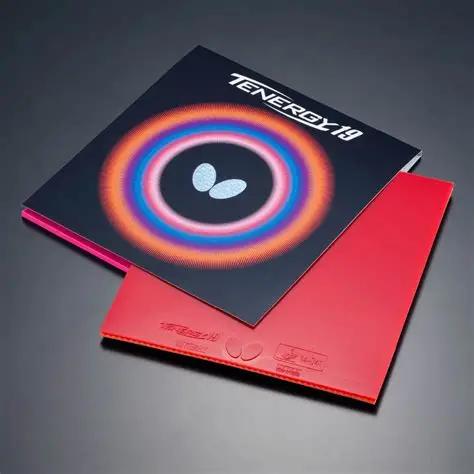
Tenergy 19 is the Tenergy-family rubber for players who want the first three touches of a point to matter. Its No. 19 pimple geometry and grippy High Tension topsheet create unusual control and bite in serves, short receives, and banana flicks, while the Spring Sponge still provides a high-arc attacking response. It is less about maximum pace than about making the serve-and-open sequence harder to read and easier to control.
Tenergy 19 suits advanced or developing offensive players who build points around serve variation, short receive, and the first topspin. It is particularly useful on the backhand for banana flicks and controlled over-the-table openings, but it can also give a forehand player more serve quality and spin variation before the rally expands. Choose it if you win points by creating awkward ball quality rather than simply hitting harder. It rewards touch, spin reading, and a willingness to attack the next ball instead of rushing every exchange.
T19 is not the best match for a player whose main plan is flat driving, mid-distance power, or immediate maximum speed. Its short-game grip and high arc are useful, but the same character can feel less direct than T64 and less explosive than T05 once the rally becomes a pure countering contest. Choose T64 for low-arc pace, T05 for a more universal topspin weapon, or Rozena if you need a more forgiving learning rubber.
Select Rubber Color: *
Please select a rubber color to add to cart
The Tenergy 19 decision guide
Tenergy 19 is a specialist within the Tenergy family. Its value appears before the big swing: a serve that carries more variation, a receive that stays short, or a banana flick that opens the point on your terms. Once the rally is open it still has Tenergy energy and a high arc, but its reason for existing is the quality of the transition from touch play into attack.
In play
The useful question is not whether Tenergy 19 is simply fast or spinny. It is how the rubber behaves in the moments that decide a point.
T19 gives the ball a grippy, sensitive contact that helps vary backspin, sidespin, and placement. It is especially useful when your plan is to make the opponent unsure whether the next ball will be short, long, or loaded.
The distinctive pimple geometry gives the backhand flick a secure feeling of holding the ball. You can brush or roll over the net with more confidence, though the surface still expects a precise read of incoming spin.
The high arc makes a safe first topspin possible, but T19 is more about setting up the rally than producing the heaviest possible opening. Place the ball intelligently and use the next ball to finish.
T19 is comfortable when the counter begins from a controlled touch, but it is not the fastest Tenergy for a pure punch game. A small active stroke keeps the ball heavy; a passive racket can send a high arc without enough depth.
This is where T19 separates itself. Pushes, drop shots, and short returns can stay compact when your hand is quiet, giving a serve-and-third-ball player more tactical choices.
Construction, translated
Creates the rubber's distinctive grip and sensitivity in low-friction short play, flicks, and serve returns.
Keeps the sheet lively enough to attack after a short exchange instead of feeling like a control-only rubber.
Adds a high-arc release and usable pace once the ball is opened up, while retaining touch on the first few shots.
Gives banana flicks and first topspins room over the net, but makes T19 less natural for flat, straight-line driving.
Makes the serve, receive, and first attack sequence the centre of the rubber's identity rather than raw rally speed.
Build the racket around it
T19 works well on a blade that gives the player enough feedback to exploit its short-game sensitivity. A stable offensive blade keeps the first attack from becoming too soft, while a flexible or inner-carbon blade gives more dwell for flicks and opening loops.
Butterfly Viscaria; Butterfly Timo Boll ALC
Adds stability and finishing power after T19 has created the opening through serve or receive.
Butterfly Innerforce Layer ALC
Gives the ball more dwell for short touch, flicks, and controlled first topspin.
Butterfly Petr Korbel; Stiga Offensive Classic
Enhances feedback and placement for a player whose game is built around touch before attack.
Buyer questions
Tenergy 05 is the broader topspin weapon: it gives more automatic attacking pace and a stronger identity in full forehand looping and counterlooping. Tenergy 19 is more specialised around serve, receive, banana flick, and short-game control, then uses its high arc to start the attack. Choose T05 if you want one rubber to cover a wide range of rally situations; choose T19 if the first three touches are where you create your advantage.
Tenergy 64 is faster and more direct, making it natural for early countering, flat drives, and a low-arc backhand. Tenergy 19 is more sensitive and grip-focused, helping short receives, serves, and flicks stay controlled before the rally opens. Choose T64 if you want to pressure through speed; choose T19 if you want to control the shape and spin of the opening exchange.
Tenergy 80 is the more neutral all-round offensive rubber, blending loop, drive, block, and counter without a strong specialist bias. T19 is more deliberately tuned toward serve and receive, short-game touch, and banana flicks, with the rally attack coming second. Choose T80 when you need a general-purpose two-winged rubber; choose T19 when your point plan begins with a carefully constructed short game.
Yes, particularly for a player who uses the backhand to receive, flick, and open rather than only counter flat. Its short-game grip and high-arc release can make banana flicks and spinny first balls more comfortable. It is not the fastest backhand option, so a player who wants every exchange to travel straight and hard may prefer T64 or Dignics 64. T19 suits a tactical backhand that creates uncertainty before acceleration.
T19 can suit a developing intermediate player who is training seriously and wants to learn serve variation, receive, and flicks, but it is not a basic beginner rubber. Its sensitivity rewards good spin reading and touch, so a player still learning fundamental contact may find it demanding in a different way than a speed rubber. Choose Rozena for a wider margin of error; choose T19 when short-game technique is becoming a deliberate part of your game.