Opening against backspin
T80 gives a comfortable lift without sending the ball as high as T05. The arc offers useful margin, while the medium release lets you continue the rally with a drive or counter instead of automatically backing away.
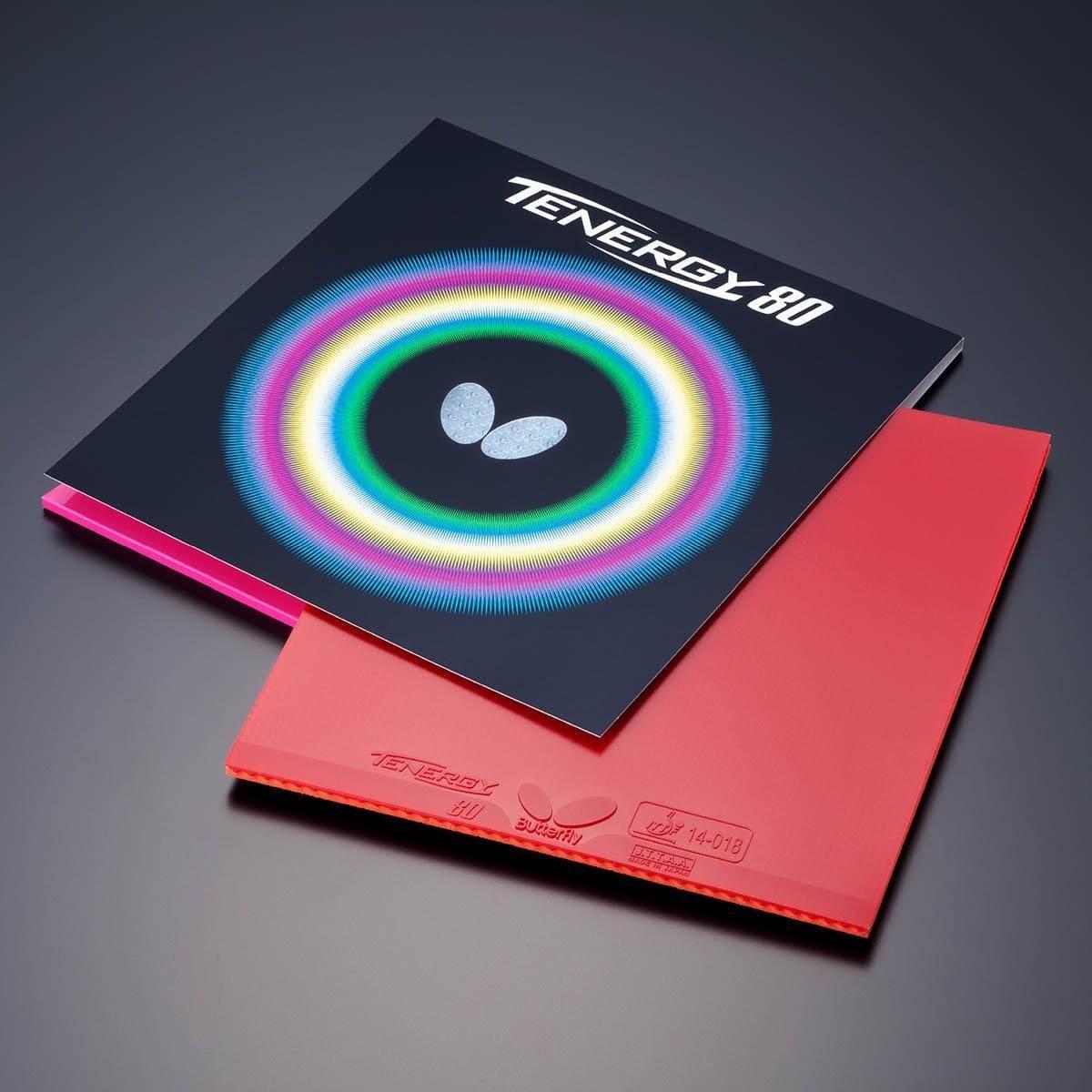
Tenergy 80 is the balanced member of the Tenergy family, combining Spring Sponge, High Tension technology, and Butterfly's No. 180 pimple geometry. It sits between Tenergy 05's high-arc looping character and Tenergy 64's flatter speed, giving an offensive player a medium trajectory that works for looping, driving, blocking, and serving. It is the Tenergy for players who want one rubber to handle many rally shapes without becoming bland.
Tenergy 80 suits intermediate to advanced offensive players who change gears often and want a rubber that does not force a single point pattern. It works well on both wings for players who loop, drive, block, and counter from different distances, with enough spin for opening and enough directness for early exchanges. It is especially useful for two-winged attackers who find T05 too arc-biased or T64 too flat. Choose it when balance and repeatability matter more than maximum spin or maximum speed.
T80 is not the ideal specialist tool for a player who wants the highest possible arc and spin on every opening loop, or the flattest and fastest counter trajectory. Choose T05 if your game is built around heavy topspin and a safe lift over the net, and choose T64 if you win by taking the ball early and driving through the bounce. Beginners may still find its tensioned response demanding; Rozena remains the softer route into this style of rubber.
Select Rubber Color: *
Please select a rubber color to add to cart
The Tenergy 80 decision guide
Tenergy 80 is designed for the player who does not want to choose between looping and driving. Its No. 180 pimple geometry and Spring Sponge create a medium trajectory: high enough to support topspin, direct enough for counters, and predictable enough for blocks and transition shots. It is less extreme than T05 or T64, which is precisely why it works so well for a versatile offensive game.
In play
The useful question is not whether Tenergy 80 is simply fast or spinny. It is how the rubber behaves in the moments that decide a point.
T80 gives a comfortable lift without sending the ball as high as T05. The arc offers useful margin, while the medium release lets you continue the rally with a drive or counter instead of automatically backing away.
The rubber keeps enough speed to trade topspin without feeling locked into a high looping flight. It is a practical middle ground for a player who sometimes counters with spin and sometimes drives through the ball.
T80 is stable when you close the racket and redirect pace. Its balanced response is forgiving across active and passive blocks, though the tensioned sponge still rewards a clean angle against heavy incoming spin.
Quick drives, flicks, and compact topspin feel natural because the release is not as high or specialised as T05. It is less brutally direct than T64, but more comfortable when the point changes from counter to loop.
The topsheet provides enough grip for varied serves and controlled returns, while the moderate arc keeps the next ball usable for either a loop or a drive. It is a strong choice for players who want consistency across the whole receive pattern.
Construction, translated
Balances speed and spin so the rubber can move between loop, drive, block, and counter without a strong single-shot bias.
Adds a lively release and enough dwell for topspin while remaining accessible on compact offensive strokes.
Keeps the sheet responsive when taking the ball early, but still leaves enough touch for controlled receive and blocking.
Sits between T05 and T64, giving more net margin than a flat counter rubber without committing every shot to a tall arc.
Makes T80 a practical two-winged choice for players who do not want to change rubbers every time their rally moves from loop to drive.
Build the racket around it
T80 pairs well with blades that let a versatile rubber remain versatile. A balanced carbon blade gives it speed for counters, while inner carbon or flexible wood adds dwell for players who want to lean more toward looping. Avoid pairing it with an extremely fast blade if the goal is all-round control.
Butterfly Viscaria; Butterfly Timo Boll ALC
Preserves T80's ability to loop and counter without making either response feel extreme.
Butterfly Innerforce Layer ALC; Butterfly Innerforce Layer ZLC
Adds dwell and comfort for a two-winged player who wants safer opening loops.
Butterfly Petr Korbel; Stiga Offensive Classic
Gives T80 more feedback and touch, creating a controlled all-round offensive setup.
Buyer questions
Tenergy 05 is more specialised for high-arc, high-spin looping, especially when opening against backspin or counterlooping from farther away. Tenergy 80 has a medium trajectory that makes it easier to blend looping with driving, blocking, and early countering. Choose T05 when spin and net clearance are the centre of your game; choose T80 when you want one rubber to stay dependable as the rally changes shape.
Tenergy 64 is the faster, flatter, more direct choice for taking the ball early and pressuring with counter drives. Tenergy 80 gives up some of that straight-line speed in exchange for more versatility and a more usable arc for looping. Choose T64 for a speed-first close-table or backhand game; choose T80 if you need to move comfortably between drive, loop, block, and counter.
Both are balanced, lower-to-medium-arc offensive rubbers, but Dignics 80 has a harder 40° Spring Sponge X and a firmer, more stable response at high impact. Tenergy 80 feels more elastic and accessible, making it easier for a wider range of attackers to use on both wings. Choose Dignics 80 when you already create high racket speed and want more authority; choose T80 for a livelier and more forgiving all-round offensive feel.
Yes. Its balanced trajectory makes it useful for compact backhand topspin, flicks, counters, blocks, and transitions between them. It is less specialised than T64 and less arc-heavy than T05, which suits a player who does not want the backhand to be only a flat counter or only a spin loop. Use T80 when you want the backhand to adapt to the incoming ball rather than forcing every exchange into one shape.
T80 is friendlier than T05 or T64 for an intermediate player because it does not exaggerate either the high arc or the fast low release. It is still a tensioned offensive rubber, so a complete beginner may find a softer sheet easier for learning contact and receive. A developing player with regular training and reasonably consistent strokes can use T80 as a growth rubber, especially on a controlled blade.