Opening against backspin
T64 can open effectively, but it asks for a more forward, accurate stroke than Tenergy 05. The lower trajectory leaves less room for a loose upward brush, so commit through the ball and use placement as much as spin.
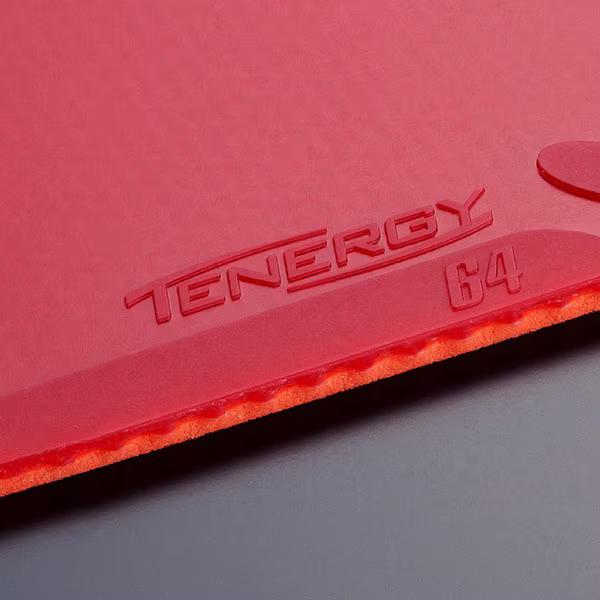
Tenergy 64 is the fastest rubber in the Tenergy family, built around High Tension technology, Spring Sponge, and Butterfly's No. 64 pimple geometry. Its lower, quicker trajectory favours direct attacks, early timing, and countering from the middle distance rather than slow, high-arc opening loops. It is a crisp, high-output choice for players who want the ball to travel through the opponent before they have time to settle.
Tenergy 64 is for advanced attackers who take the ball early, counter with pace, and prefer a direct trajectory over a high looping arc. It is particularly effective on the backhand for crisp counters, active blocks, punches, and quick opening topspin, but strong forehand drivers can use it from middle distance too. Choose it if your game is built around speed, timing, and pressure through the bounce. It rewards a player who can create a clean contact point and wants the rubber to add pace without becoming a flat-hitting specialist sheet.
T64 is not the best match for players whose first priority is maximum brush spin, a high safety arc against heavy backspin, or a soft, dwell-heavy feel. Players who loop slowly from behind the table may find the lower release less forgiving than Tenergy 05, while beginners may struggle to control its quick rebound. Choose T05 for a higher opening window, T80 for a more balanced arc, or Rozena for a softer and more forgiving step into tensioned rubber.
Select Rubber Color: *
Please select a rubber color to add to cart
The Tenergy 64 decision guide
Tenergy 64 is the Tenergy rubber for a player who would rather arrive early than arrive dramatically. Its No. 64 pimple geometry and Spring Sponge create a quick, direct release that keeps attacks low and fast. The reward is immediate pressure in counter rallies and middle-distance exchanges; the trade-off is less natural help when you want to lift a heavy push on a tall arc.
In play
The useful question is not whether Tenergy 64 is simply fast or spinny. It is how the rubber behaves in the moments that decide a point.
T64 can open effectively, but it asks for a more forward, accurate stroke than Tenergy 05. The lower trajectory leaves less room for a loose upward brush, so commit through the ball and use placement as much as spin.
This is T64's strongest setting. The ball leaves quickly and travels through the rally with a direct shape, allowing you to redirect an opponent's pace before they can reset their position.
The quick rebound makes active blocks and punch counters feel decisive. Close the racket against heavy topspin and let the rubber's speed turn a compact contact into a deep return.
T64 is comfortable when the point is played at the table: quick counters, backhand drives, and early timing all feel natural. It is less forgiving when you want to slow the ball down with a loose or late touch.
The topsheet can produce heavy spin with a clean brush, while the lower arc helps keep direct returns fast and hard to attack. The tensioned rebound still demands a precise racket angle on short receive.
Construction, translated
Shapes the release toward speed and a lower trajectory, making the rubber feel faster and more direct than Tenergy 05.
Gives compact strokes immediate energy, useful for early countering and backhand pressure close to the table.
Adds a springy response without making T64 a pure flat-hit rubber; clean contact still produces topspin and controlled depth.
Keeps attacks travelling through the opponent rather than climbing high, but asks for a more exact racket angle against backspin.
Makes T64 a natural choice for players who win time and position with pace, not for players who want the rubber to supply maximum brushing spin.
Build the racket around it
T64 works best on a blade that gives its fast release enough stability and touch. A controlled carbon blade can sharpen early countering, while a flexible or inner-carbon blade adds dwell for players who still want to open with topspin. Avoid pairing it with an extremely fast blade unless your short game is already disciplined.
Butterfly Viscaria; Butterfly Timo Boll ALC
Keeps T64 stable during fast exchanges while preserving enough dwell for active topspin.
Butterfly Innerforce Layer ALC
Softens the first contact and gives a direct rubber more room for controlled opening loops.
Butterfly Petr Korbel; Stiga Offensive Classic
Adds feedback and dwell, creating a more rounded setup for a player transitioning toward direct offensive play.
Buyer questions
Tenergy 64 is the faster and more direct option, with a lower trajectory suited to early countering, driving, and middle-distance attack. Tenergy 05 gives a higher, safer arc and more spin-oriented response for opening against backspin and looping from farther away. Choose T64 if you win points by taking time away; choose T05 if you build the point by lifting, curving, and loading the ball with topspin. A common combination is T05 forehand with T64 backhand.
Tenergy 64 has the stronger speed and directness bias, making it especially good for close-table countering and crisp backhand pressure. Tenergy 80 sits closer to the middle: it blends looping, driving, blocking, and transition play with fewer extremes. Choose T64 when your stroke pattern is aggressive and early; choose T80 if you need one rubber to handle more different rally shapes without committing to a low trajectory.
Both target direct, fast attacking play, but Dignics 64 uses a harder 40° Spring Sponge X and feels firmer and more stable at high impact. Tenergy 64 has the softer 36° Spring Sponge response and is more accessible for players who want quick pace without as hard a contact. Choose Dignics 64 when you already supply high racket speed and want extra authority; choose T64 for a livelier, more approachable countering feel.
Yes, backhand is one of its most natural placements. The fast release supports compact counters, punches, active blocks, and early topspin without requiring a long backswing. It is especially useful for a player who wants the backhand to take time away rather than arc high from mid-distance. It can still work on the forehand for a direct attacker, but players who rely on heavy forehand brushing may find Tenergy 05 more forgiving.
It is not a beginner-first rubber because the quick rebound and lower trajectory expose loose timing and racket angles. A technically solid intermediate player who trains regularly and prefers direct countering can use it, particularly on the backhand, but should pair it with a controlled blade while adapting. If you are still learning to open against backspin or need more dwell to feel the ball, Rozena or Tenergy 80 will usually be easier to develop with.