Nittaku Fastarc G-1
Rubber

Nittaku Fastarc G-1

4.8 (73 reviews)

Nittaku Fastarc G-1 is a high-performance German-made tensor developed for Nittaku players whose game is built around fast, spin-driven topspin. Its 47.5° sponge gives the rubber a stable, powerful base, while the grippy topsheet produces a precise curved trajectory for opening loops, counterloops, flicks, and heavy serves. G-1 is quick enough for higher-speed rallies and semi-distance play, but its character is more controlled and linear than an extreme catapult rubber. Best for advanced offensive players who want dependable spin, strong placement, and a durable all-round topspin weapon on either wing.

Who this is for

Fastarc G-1 suits intermediate-to-advanced and advanced offensive players who want one rubber to handle opening loops, counter topspin, active blocks, flicks, and spinny serves. It is especially popular on the forehand for players who brush and drive through the ball, but it can also be an excellent backhand rubber for an active player who values grip, compact power, and placement. Choose it when you want a firm 47.5° feel, a high curved arc, and enough speed for semi-distance play without an uncontrolled trampoline response.

Who this is not for

G-1 is not the softest progression rubber for complete beginners, passive blockers, or players who still struggle with racket angle and timing. Its 47.5° sponge rewards acceleration but can feel demanding on short or late strokes, and the grippy topsheet makes loose receive contacts sensitive. Players who want effortless catapult should look at a bouncier rubber; players who want a very flat, low-arc punch response may prefer a speed-oriented rubber such as Dignics 64.

Specifications

Sponge hardness
47.5° (medium-hard)
Manufacturing origin
Made in Germany
Specialist ratings
Speed 96 / Spin 96 / Control 68
Rubber type
Inverted pimple-in tension rubber
Playing character
Fast, spin-driven, grippy, precise, moderately catapulted
Arc
High curved trajectory for topspin play
Best strokes
Opening loop, counterloop, flick, spinny serve, fast drive
Best range
Close to the table through semi-distance
Best placement
Forehand for topspin; backhand for advanced active play

Select Rubber Color: *

Please select a rubber color to add to cart

₹3,999
₹4,999Save 20%

🚚 Fast Delivery Across India

  • ✓ Standard Shipping: ₹100 (FREE above ₹5,000)
  • ✓ Express Shipping: 1-2 business days
  • ✓ Cash on Delivery available

The Fastarc G-1 decision guide

Fastarc G-1: precise spin with serious pace

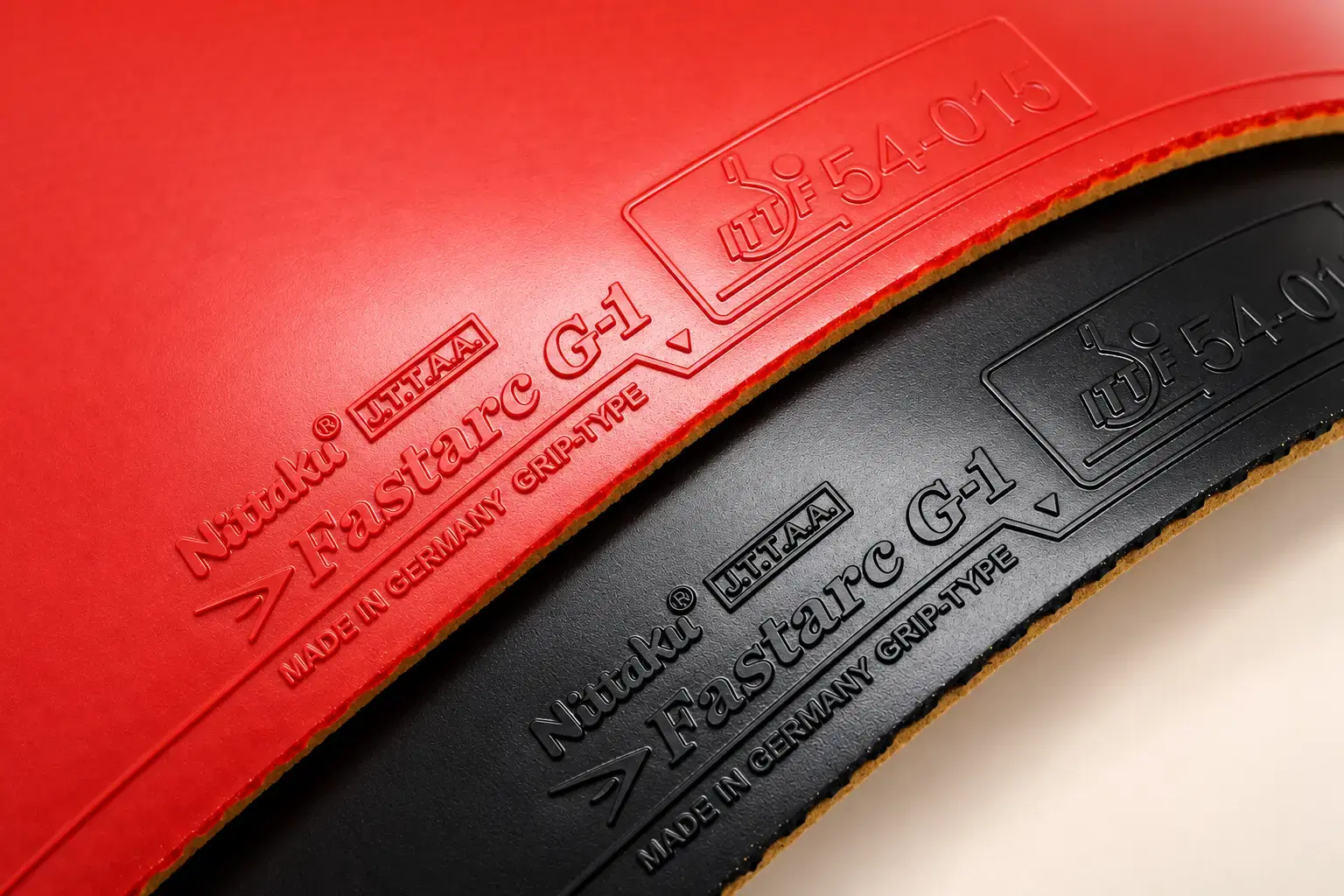
Fastarc G-1 has become a reference choice for players who want a high-quality topspin rubber without an exaggerated catapult. The 47.5° sponge provides stability and power, while the grippy topsheet helps shape a curved, heavy ball that can be placed with intent. G-1 feels lively when engaged but not chaotic: it rewards a complete stroke, keeps serves and flicks dangerous, and remains useful when the rally moves from the table to semi-distance.
In play

What does Nittaku Fastarc G-1 actually feel like?

The useful question is not whether Nittaku Fastarc G-1 is simply fast or spinny. It is how the rubber behaves in the moments that decide a point.

Opening against backspin

The grippy surface and high arc make it natural to lift a push with a loaded first loop. G-1 rewards brushing with forward acceleration; the ball feels secure when the stroke is complete, but a soft or late contact can lack depth.

Counterlooping from semi-distance

The firm sponge gives G-1 enough reserve for fast counter topspin while its curved trajectory keeps the ball dangerous after the bounce. It feels more precise and less wildly springy than an extreme catapult rubber.

Blocking and taking the ball early

Active blocks and compact counters are stable when the racket angle is set early. Passive blocking takes more care because the grippy topsheet and tensioned sponge preserve incoming energy instead of simply absorbing it.

Close-to-table attack

Flicks, quick topspin, and fast drives are strong uses for G-1. It can create speed from a compact stroke, but the player still needs a deliberate hand in short play and a precise contact against heavy incoming spin.

Serving and receiving

G-1 is well suited to spinny serves and controlled placements because the topsheet grips the ball cleanly. On receive, the same grip makes spin reading important; a quiet hand and accurate racket angle help keep pushes short and flicks precise.

Construction, translated

What makes Nittaku Fastarc G-1 different?

47.5° sponge ->

Balances high-speed output with stability, giving strong loopers a reliable platform for both power and placement.

Grippy topsheet ->

Supports heavy serves, flicks, and opening loops while keeping the response non-tacky and suitable for quick European-style offense.

Precise curved trajectory ->

Helps the ball clear the net and drop onto the table with a high-quality topspin shape rather than a purely flat launch.

Moderate catapult ->

Adds pace when the sponge is engaged but remains more predictable than the most trampoline-like tensors, which helps active players control placement.

Close-to-semi-distance range ->

Keeps G-1 useful for quick table pressure and longer topspin exchanges, provided the player supplies reliable acceleration.

Build the racket around it

Best blade pairings for Nittaku Fastarc G-1

Fastarc G-1 pairs best with a stable offensive blade that lets its grip and curved trajectory work without making the short game too sharp. Outer carbon increases countering speed, inner carbon adds dwell, and controlled offensive wood brings out the rubber's feedback and placement.

Balanced outer carbon

Butterfly Viscaria; Nittaku Acoustic Carbon

Gives G-1 a stable platform for fast loops and counters while preserving its high-spin curved trajectory.

Inner carbon

Butterfly Innerforce Layer ALC; Nittaku Acoustic Inner

Adds dwell and comfort to the firm sponge, helping opening loops and receive feel more controlled.

Flexible offensive wood

Butterfly Petr Korbel; Nittaku Acoustic

Enhances feedback and ball hold for players who want G-1 spin and speed with a more natural first contact.

Buyer questions

Nittaku Fastarc G-1 FAQ

What is the difference between Fastarc G-1 and Fastarc C-1?+

G-1 is the firmer, faster, and more power-oriented option, with a 47.5° sponge suited to committed topspin and counterlooping. C-1 is softer and more accessible, giving easier dwell and control on compact strokes. Choose G-1 when you already accelerate confidently and want more pressure; choose C-1 when you want a gentler route into modern tensor offense.

What is the difference between Fastarc G-1 and Tenergy 05?+

Both are grippy, high-arc topspin rubbers, but G-1 feels firmer, more linear, and more controlled in fast rallies, while Tenergy 05 has a more elastic and pronounced high-throw identity. G-1 is attractive for players who want precise placement, serves, and counterlooping without excessive catapult; T05 suits players who want a classic lively high-arc looping response.

What is the difference between Fastarc G-1 and Andro Rasanter R47?+

Both use a medium-hard sponge and suit fast topspin, but G-1 is generally valued for its stable, precise, moderately catapulted response, while Rasanter R47 feels more directly tuned toward speed and a lively curved trajectory. Choose G-1 for controlled spin, placement, and dependable two-winged play; choose R47 if you want a more energetic European tensor feel and stronger immediate pace.

Is Fastarc G-1 good for the backhand?+

Yes, especially for an advanced player who uses the backhand actively. G-1 supports flicks, compact loops, counters, and spinny serves while the 47.5° sponge gives the stroke stability. It is less suitable for passive blocking or late contact, so a controlled or inner-carbon blade can help make the backhand more manageable.

Is Fastarc G-1 good for beginners?+

Usually not as a first rubber. The 47.5° sponge, high spin, and tensioned response reward correct timing but give less forgiveness when the stroke or racket angle is inconsistent. A technically solid intermediate player can grow into G-1 with coaching and regular practice, but a softer tensor will generally make learning the fundamentals easier.